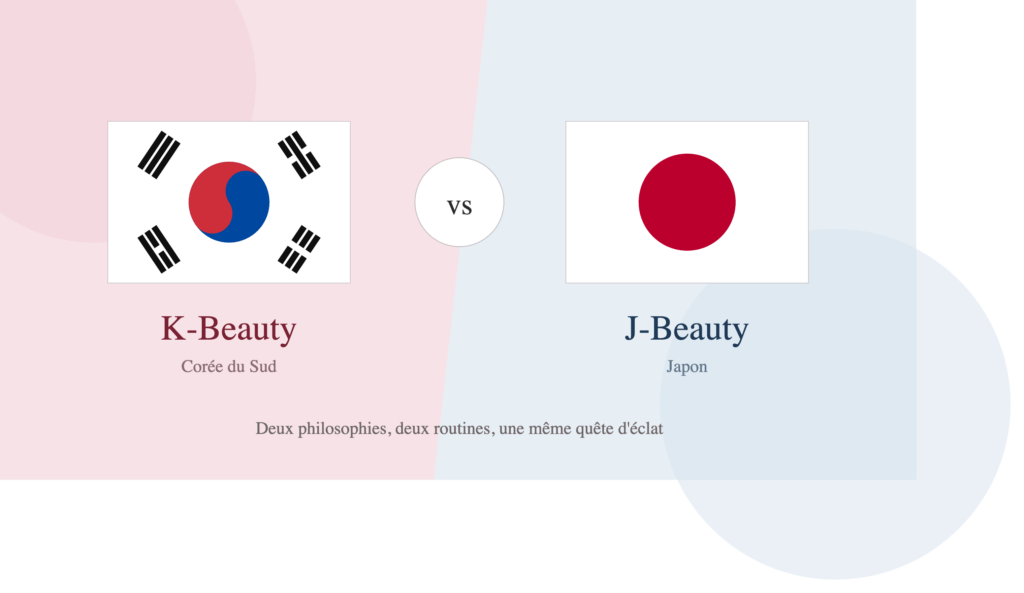
After covering the rise of K-Beauty at Erborian, one question keeps coming up: what about J-Beauty, Japanese beauty? The K-Beauty vs J-Beauty debate isn’t just a matter for enthusiasts, it’s a real strategic choice for any brand looking to position itself in Asian beauty.
What K-Beauty and J-Beauty actually mean
Before comparing the two markets, a quick definition is worth setting straight, since the two terms cover quite different realities.
K-Beauty (short for « Korean Beauty ») refers to cosmetics and skincare rituals originating in South Korea, popularised internationally from the early 2010s onward. Its defining trait is a multi-step routine, the famous « 10-step routine », along with formats that became global icons: BB creams, which Erborian itself pioneered in the West, single-use sheet masks, and concentrated essences. South Korea also invests heavily in cosmetics R&D, running one of the fastest new-product launch cycles in the world.
J-Beauty (for « Japanese Beauty ») covers Japanese cosmetics and skincare philosophy, with a much longer history: brands like Shiseido have been around for more than a century. Unlike Korea’s multi-step routine, J-Beauty favours a handful of versatile but highly concentrated products, built around traditional ingredients (fermented rice, green tea, seaweed, thermal spring water). It notably popularised fermented essences (SK-II being the best-known example) and the double-cleansing principle, a method now widely adopted worldwide, including by K-Beauty itself.
Two philosophies at odds
K-Beauty bets on constant innovation: new actives, new textures, new formats, a routine that can run up to ten steps. J-Beauty, by contrast, cultivates a minimalist, heritage-driven approach: few products, formulas proven over decades, a routine built to last rather than to chase trends.
Two markets, two speeds
The J-Beauty market is growing at around 6.3% compound annual growth, while K-Beauty posts a markedly more aggressive trajectory (roughly twice as fast). The J-Beauty market was valued at around $39 billion in 2026 (compared with the $15.4 billion export-value figure for K-Beauty cited in our previous article; different methodologies, but the gap in momentum is clear).
Geographic distribution confirms this difference: J-Beauty remains heavily concentrated in Asia-Pacific (60%+ of revenue), while K-Beauty has gone thoroughly global, with North America accounting for more than a third of its sales.
Why the pace gap
K-Beauty’s engine remains cultural and viral: K-pop, K-dramas, influencers. J-Beauty rests on a reputation for quality built over the long term, carried by brands like Shiseido or SK-II.
What this means for a brand or seller
- The K-Beauty narrative lends itself to novelty: frequent launches, trend-driven content.
- The J-Beauty narrative lends itself to durability: a formula’s long track record.
- Both share a demand for scientific proof, echoing cosmetic ingredient transparency: customers want facts, not just a cultural promise.
My take
Having run a K-Beauty brand for several years, I see J-Beauty not as a direct competitor but as a useful counterpoint. The most interesting brands borrow from both schools rather than staying locked in one camp.
Agathe Blaise
Sources: K-Beauty Products Market Report – Grand View Research, K-Beauty Products Market Size, Share, Growth Report 2026 – The Business Research Company, J-Beauty Products Market Size & Share Report, 2026-2033 – Grand View Research.